Is localised heavy rain becoming more common?
20 July 2026
LEUNG Lai-lai, WU Man-chi, SO Chi-wai Andy
Have you ever been caught in a sudden torrential downpour, only to find that another district had little or no rain at all? Are these short, intense and isolated rain events becoming more common in recent years? Using data from over a hundred automatic rain gauges across Hong Kong during the wet seasons from April to October between 2000 and 2024, the Observatory found that short-duration heavy rain events lasting 1 to 3 hours have shown a significant increasing trend, with many of them being highly localised.
What is “short-duration heavy rain”?
Short-duration heavy rain refers to heavy rain that occurs over a short period of time. According to the definition used in this study by the Observatory, such an event occurs when any rain gauge in the territory records rainfall of 30 mm1 or more per hour, and the entire rainfall process lasts only 1 to 3 hours.
“Short-duration heavy rain” accounts for nearly 40% of all heavy rain events
During the wet seasons from 2000 to 2024, the study identified 557 short-duration heavy rain events, accounting for about 38% of the analysed heavy rain events. The other events were medium-duration events lasting 4 to 6 hours and long-duration events lasting more than 6 hours. The data indicated that heavy rain events lasting 2 to 3 hours were the most common.
“Why no Rainstorm Warning is issued when it is raining so heavily here?”
Short-duration heavy rain is not necessarily a widespread rainstorm. The data indicates that these events are often highly localised. To objectively describe the spatial extent of heavy rain, this study adopted established methodologies in a previous analysis of rainstorms in Hong Kong, and divided the territory into 41 zones. These zones were defined based on rain gauge locations, spatial correlation of rainfall, and geographical distribution, with each representing the rainfall conditions of a small and comparable area. The highest hourly rainfall recorded was taken as its representative value for each zone. The study then assessed how many zones recorded an hourly rainfall of 30 millimetres or above during a specific event to determine whether a rainstorm was localised or widespread. The results reveal that among the 557 short-duration heavy rainfall events, about 40% affected only a single zone, and nearly 60% were confined to just one to two zones.
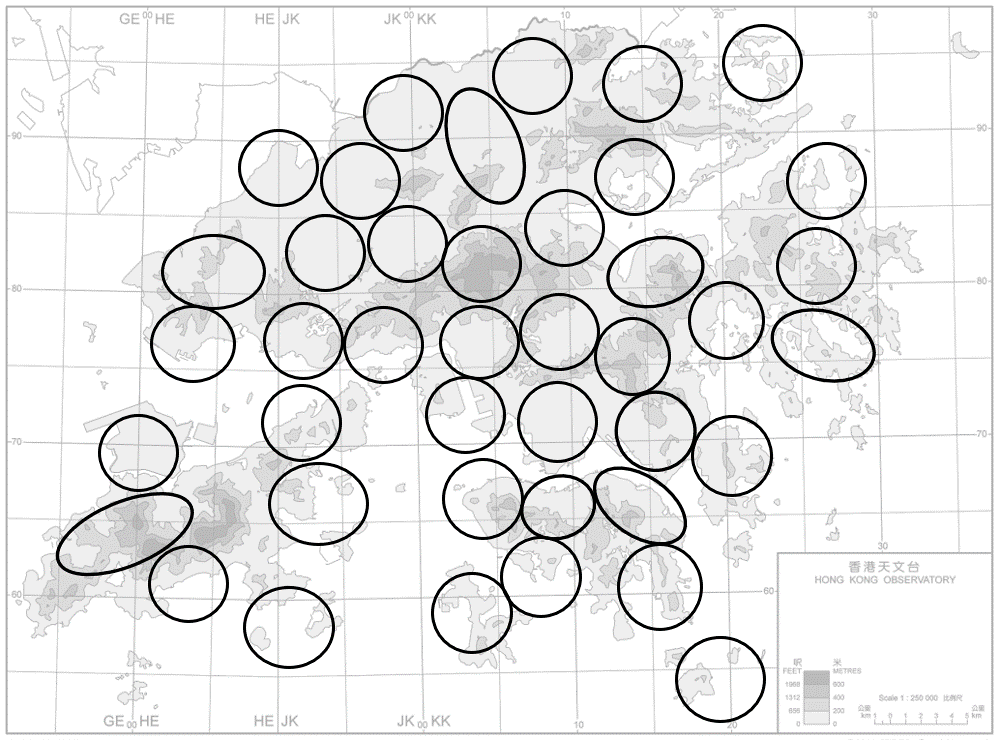 Figure 1. The study divided Hong Kong into 41 zones.
In other words, when short-duration heavy rain occurs, it may lead to situations where for one area experiences intense rain while other areas remain largely unaffected. This also explains why, at times, heavy rain in localised areas may not meet the criteria for issuing a rainstorm warning signal, which take into account rainfall over widespread areas.
A small affected area does not mean insignificant rain
Although short-duration heavy rain usually affects a smaller area than longer-lasting rainstorms, this does not mean it is less intense. The analysis showed that some short-duration heavy rain events still recorded more than 100 mm of rainfall in an hour, reaching the level of “Severe Rainstorm”. In other words, even if the rain lasts only one or two hours, it can still bring very intense rainfall within a short time and pose a serious threat to people engaged in outdoor activities or work.
Short-duration heavy rain has shown a significant upward trend
Notably, short-duration heavy rainfall in Hong Kong has shown a significant upward trend over the past 25 years, with its frequency increasing by 3.4 events per decade, reaching statistical significance. By contrast, heavy rain events lasting more than 4 hours did not show a significant increase.
A regional analysis also found upward trends across Hong Kong, with the increase being most pronounced in the New Territories East.
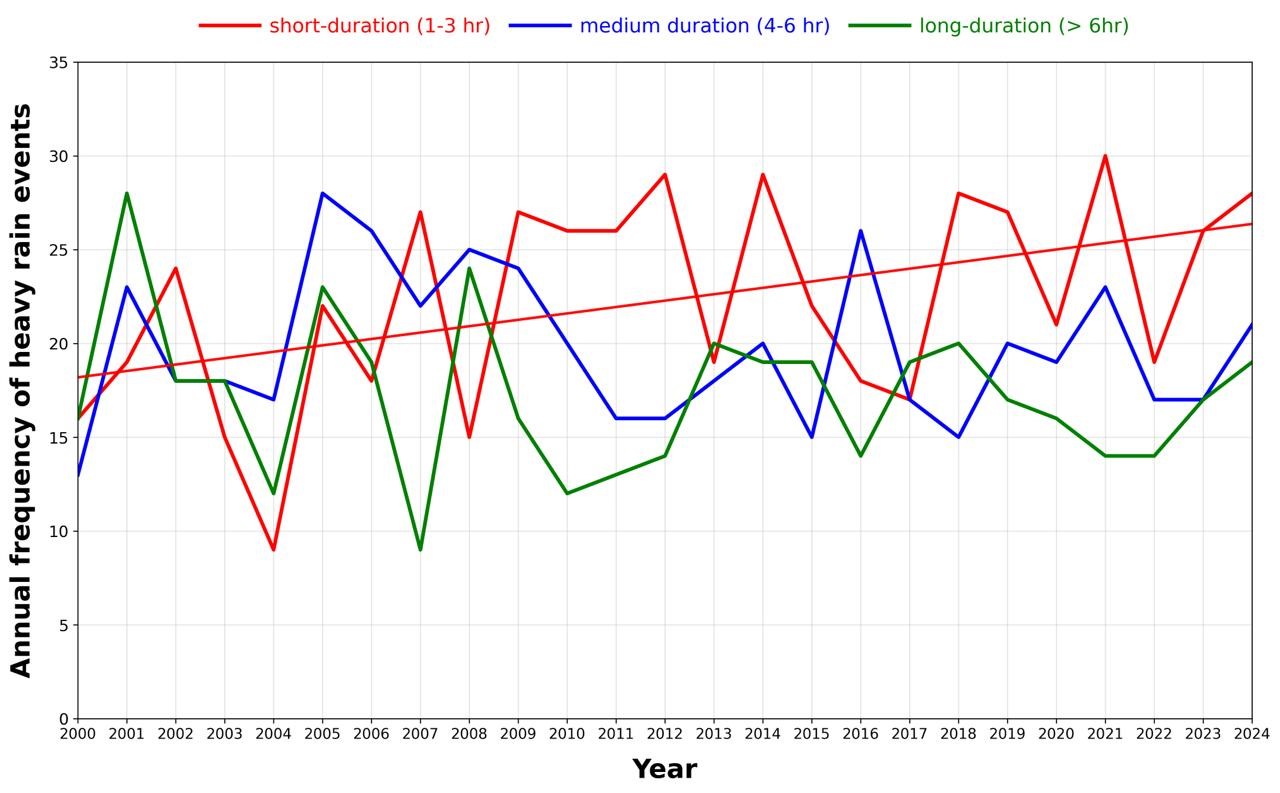
Figure 2. Time series of the annual frequency of short-duration (red), medium-duration (blue), and long-duration (green) heavy rain events in Hong Kong during the wet season in 2000–2024. The trend lines indicate a significant upward trend for short-duration events, while medium- and long-duration events did not show statistically significant trends.
Short-duration heavy rain occurs more often in the afternoon
In terms of temporal distribution, short-duration heavy rain occurs more frequently from around noon to early afternoon. This pattern suggests that solar heating may play an important role. As the ground warms up, the air near the surface rises, which is more favourable for convective development, allowing rain clouds to form rapidly and produce heavy rain. By contrast, longer-duration heavy rain events occur more often from around midnight to early morning. This reflects differences in the triggering mechanisms behind heavy rain events of different durations.
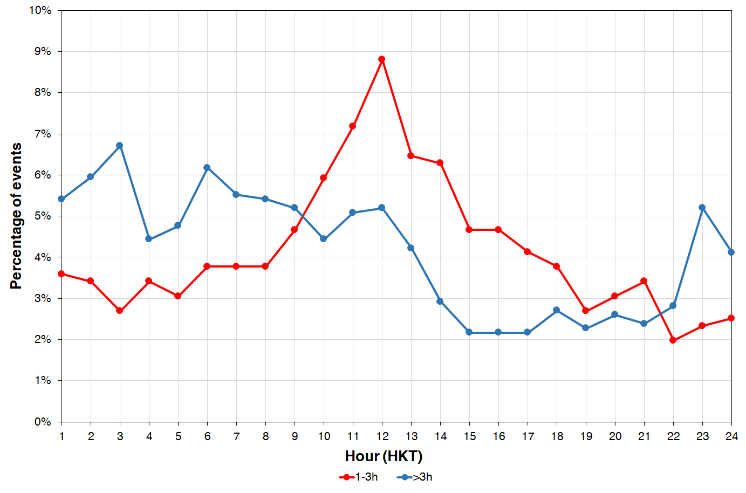
Figure 3. Time of occurrence of short-duration heavy rain events (1–3 hours : red) and longer-duration heavy rain events (more than 3 hours : blue) in Hong Kong during the wet season in 2000–2024.
Different mechanisms to trigger short-duration heavy rain
People may usually associate the heavy rain in Hong Kong with troughs of low pressure or tropical cyclones. However, the study found that the mechanisms behind short-duration heavy rain are not the same. About 41% of these events were related to surface troughs, 15% to tropical cyclones, while the remaining 44% are triggered by “other mechanisms”.
These “other mechanisms” include the monsoon, upper-air disturbances, or convective activity developing under relatively weak synoptic conditions. Past data suggest that short-duration heavy rain is generally associated with a less stable atmospheric environment. Among events classified under “other mechanisms”, daily maximum temperatures are generally higher, and some cases also occur under weaker winds and in the absence of a clear large-scale weather system. This shows that many short-duration heavy rain events are closely related to convective development triggered by smaller-scale weather and thermodynamic processes.
The study also points out that the increasing trend in short-duration heavy rain may reflect the local urbanisation effects and orographic effect of Hong Kong’s terrain on airflow uplift and rainfall distribution.
Stay tuned of the latest weather information
Besides the Rainstorm Warning Signals, the Observatory also provide advisories and reports specially for localised heavy rain.
When heavy rain affects the northern New Territories and flooding occurs or is expected to occur in low-lying areas there, the Observatory will issue the “Special Announcement on Flooding in the northern New Territories” to alert the public and relevant sectors to take precautionary measures. In addition, when individual districts record or are expected to receive heavy rain exceeding 70 mm in an hour, but the rain has not become widespread enough so that the threshold for the Red or Black Rainstorm Warning Signal has not been reached, the Observatory will issue the “Localised Heavy Rain Advisory”, listing the affected areas and relevant rainfall information , reminding the public that flooding may occur in those areas and that appropriate precautions should be taken.
Although short-duration heavy rainfall is often brief and may not affect a wide area, it can be very intense and should not be overlooked. The findings indicate that such rainfall events are increasing in Hong Kong, warranting greater public awareness. Especially during the rainy season, the public should pay close attention to the latest weather information and warnings issued by the Observatory, and take appropriate precautionary measures to cope with rapidly developing heavy rain.
1Hourly rainfall of 30 mm is classified as “heavy rain”. When widespread areas in Hong Kong have recorded or are expected to receive rainfall exceeding 30 mm per hour, and the rain is likely to continue, the Observatory will issue the Amber Rainstorm Warning Signal.