Extreme Cold Surge in Hong Kong
Extreme Cold Surge in Hong Kong
LAO Wing-kwan, CHONG Man-lok, YEUNG Hon-yin
December 2025
Under the background of global warming, the mean temperatures over Hong Kong have shown a marked increasing trend in the past 30 years [1]. However, sporadic cold surge in winter may still bring persistent windy weather and low temperatures to Hong Kong. In extreme cases, cold surges could pose serious threat to health.
Cold air masses that affect east Asia originate from the Arctic or Siberia. In winter, whenever an upper-air westerly trough moves across the region and extends southwards, the cold air mass could be driven towards central and eastern China [2]. If the circulation of westerlies slows down and becomes meandering, or even exhibits the pattern of a “blocking high”, it will be easier for polar cold air to pile up and spread southwards. The blocking high usually establishes near the Ural Mountains, favouring arctic cold air to accumulate over the eastern flank of the blocking high. When the blocking high collapses, together with the westerly trough aloft Siberia to northern China deepening towards the south while moving to the east, the cold air mass will invade southwards and trigger a large scale cold surge (Figure 1) [3]. Depending on the strength of cold air masses and the detailed synoptic settings at mid-latitudes, polar cold air masses may or may not be able to successfully reach the southern China.
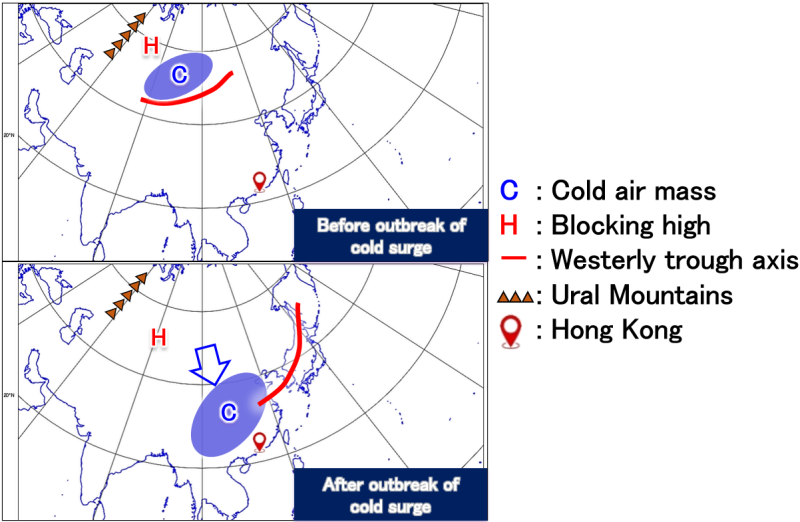
Figure 1 Typical evolution in weather pattern leading to an outbreak of a cold surge — A blocking high near Ural Mountains and an upper-air westerly trough over Siberia to northern China deepening southwards while moving east, triggering large-scale cold surge in the southern part of China.
China is a vast country with large differences in climate between the north and the south. There is not any single unified criterion for classifying cold surges. Different provinces or cities generally classify a cold surge based on the temperature drop, minimum temperature and mean wind strength associated with the cold air mass. In Hong Kong, a simple classification of cold surges can be made in accordance with the results of the Observatory’s research on extreme weather of local winters [4]. If a cold air mass causes temperatures in the urban areas plummeting within one or two days, down to “very cold” level (7 degrees or below), and with wind strength reaching gale force, the cold process could be classified as an “extreme cold surge”. That research shows that in 1991-2020, there were only 4 cold events that could meet the criteria of “extreme cold surge” in Hong Kong (in 1991, 1993, 2010 and 2016). Looking at the records of the past few years, “extreme cold surge” has not recurred in the three winters between 2021 and 2024 (counting up to February 2025). Cold processes that could not be classified as “extreme cold surge” would normally be described as winter monsoon or northeast monsoon. If the monsoon brings cold weather locally with strong winds, the monsoon would be described as an “intense winter monsoon”.
The last invasion of extreme cold surge to Hong Kong dated back to January 2016, when the cold surge literally “froze” the entire southern China, remaining fresh in memory of many people. At that time, the daily minimum temperature at Hong Kong Observatory plunged 8 degrees within two days from 21 to 23 January, and the minimum temperature even reached 3.1 degrees on 24 January, the lowest since 1957 (Figure 2(a)). Besides, gale force northerly winds prevailed offshore and on high ground, with Waglan Island recorded maximum sustained wind speed of 76 kilometres per hour. It was even more frigid over Tai Mo Shan with widespread icing (Figure 3(a)). The wind chill effect was also very severe, affecting more than 120 hikers and cross-country runners who needed rescue due to icy roads and low temperatures near the top of Tai Mo Shan. Among them, more than 60 had to be hospitalized due to hypothermia.
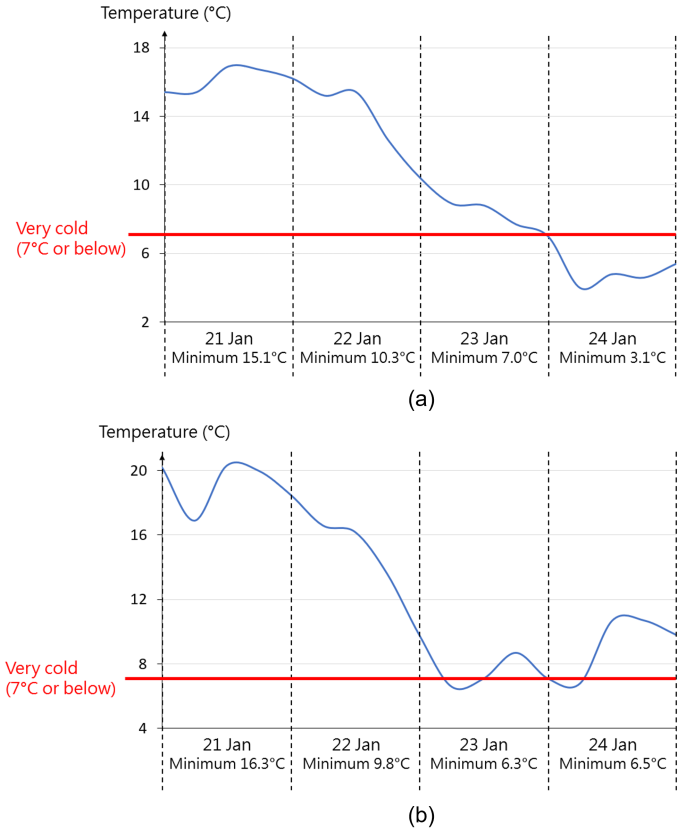
Figure 2 Time series of temperature during cold surges (HKO Headquarters): (a) 21-24 January 2016; (b) 21-24 January 2024.
Almost at the same time 8 years later in 2024 (late January, a few days after “Severe Cold” of 24 Solar Terms), another intense cold air mass swept across southern China. The perturbed flows in the southern branch of the westerlies also brought overcast and rainy weather to the region. Due to the effect of evaporative cooling, temperatures over Hong Kong fell rapidly to the “very cold” level, with daily minimum temperatures at the Observatory dropped by 10 degrees within two days and stayed slightly below the upper limit of "very cold” on both 23 and 24 January 2024 (Figure 2(b)). Temperatures at Tai Mo Shan even fell below zero degrees and there were icing reports (Figure 3(b)), somewhat reminiscent of the situation in the extreme cold surge in 2016. There were strong northerly winds offshore and on high ground, and wind chill effect was significant. Yet, local winds did not reach gale force with reference to the maximum wind speed recorded at Waglan Island. Therefore, this cold event could not add to the list of extreme cold surge strictly speaking but be appreciated as a very powerful “intense winter monsoon”.
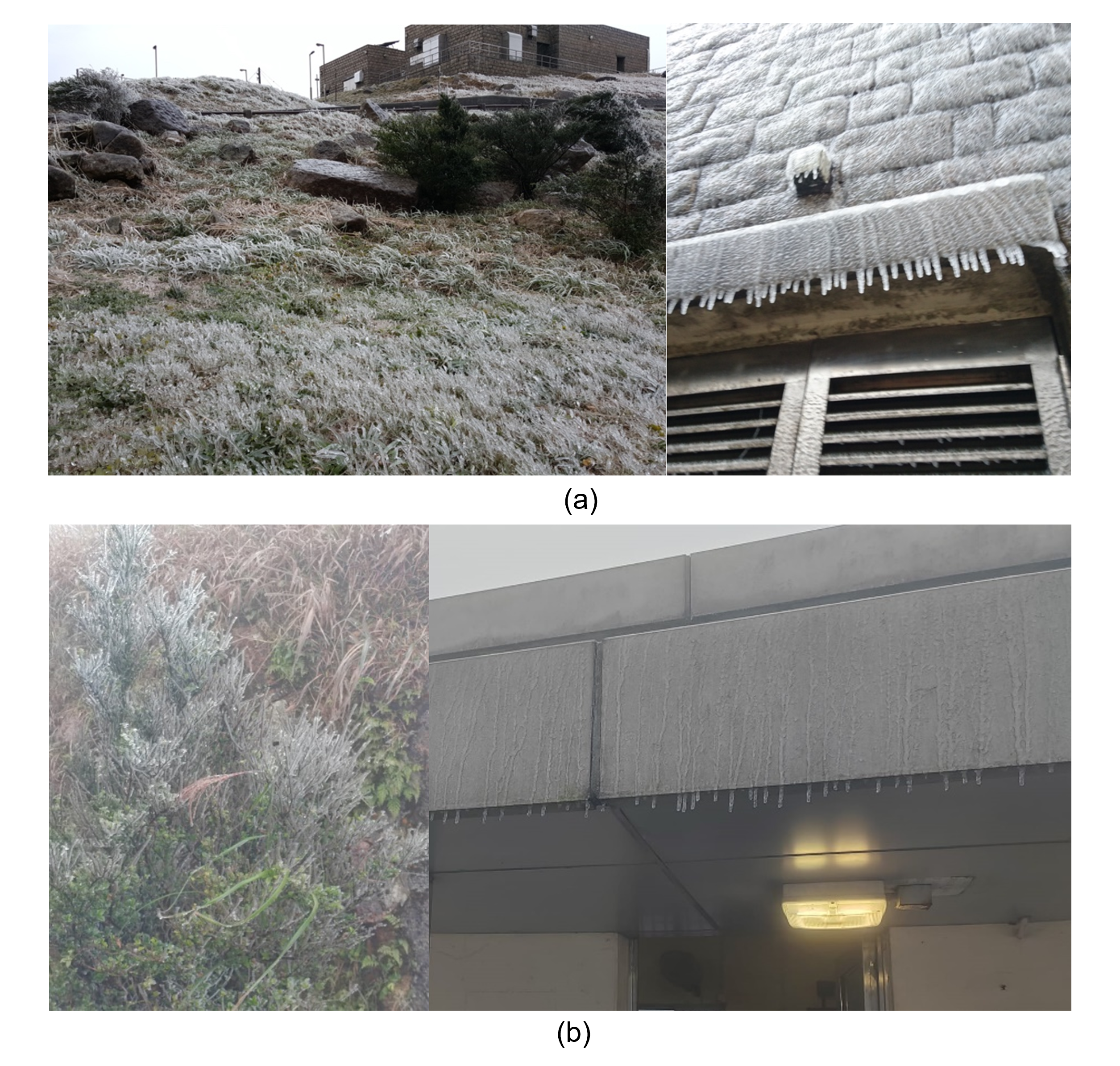
Figure 3 Icing observed at Tai Mo Shan under cold surges: (a) 24 January 2016; (b) 23 January 2024.
Climate change is a game changer, reducing the number of cold days in Hong Kong gradually in the foreseeable future. But still, cold days will not completely disappear [5]. Even under mild winter days, please stay vigilant against the weather changes. If forecasts of “intense winter monsoon” or even “extreme cold surge” emerge again, please do not underrate the potential impacts to the surrounding environment and individual health brought about by rapid weather changes, say icy roads, wind chill effect and hypothermia!
References:
[1] Hong Kong Observatory: Climate Change in Hong Kong - Temperature
[2] Hong Kong Observatory: Weather Note – How do cold surges reach Hong Kong (in Chinese only)
[3] China Meteorological Administration: Global warming increases extremity of cold surges (in Chinese only)
[4] M.L. Chong, H.Y. Yeung and K.K. Hon: Study of extreme cold surges in Hong Kong
[5] Hong Kong Observatory: Projection data of cold days for Hong Kong
[1] Hong Kong Observatory: Climate Change in Hong Kong - Temperature
[2] Hong Kong Observatory: Weather Note – How do cold surges reach Hong Kong (in Chinese only)
[3] China Meteorological Administration: Global warming increases extremity of cold surges (in Chinese only)
[4] M.L. Chong, H.Y. Yeung and K.K. Hon: Study of extreme cold surges in Hong Kong
[5] Hong Kong Observatory: Projection data of cold days for Hong Kong