An Economical and Easy Way to Measure Radiation
An Economical and Easy Way to Measure Radiation
Yeung Siu-wai
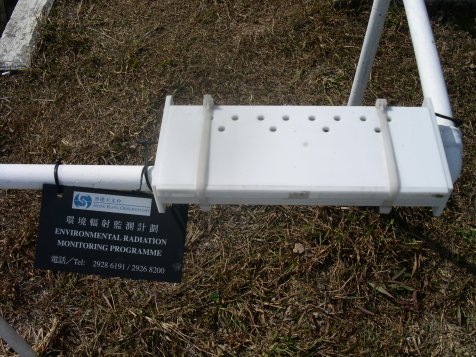
Figure 1 Environmental Radiation Monitoring Programme.
Have you ever seen a white box as shown in Figure 1 at some places like schools in Hong Kong? Do you know what is inside, and what is it used for?
What is inside the white box?
The white box houses a batch of 5 thermoluminescent dosimeters (TLDs). It can be found at monitoring sites of the TLD network maintained by the Hong Kong Observatory (HKO). It is used for measurement of ambient gamma radiation level as part of the Observatory's Environmental Radiation Monitoring Programme (ERMP).
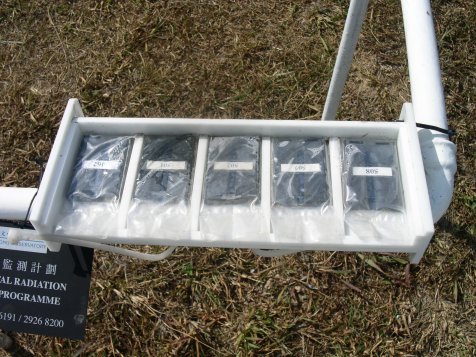
Figure 2 A batch of five TLDs inside the white box at one of the monitoring sites.
What is a TLD network?
The HKO has maintained a TLD network under the ERMP since the late 1980s to measure ambient gamma doses accumulated over a long period. The network, comprising 27 monitoring points over the territory, provides a wide spatial coverage of ambient radiation monitoring in Hong Kong economically. A batch of five identical TLDs is placed at each site to ensure statistical accuracy. They are replaced once every three months and the amount of radiation exposure is measured by a reader.
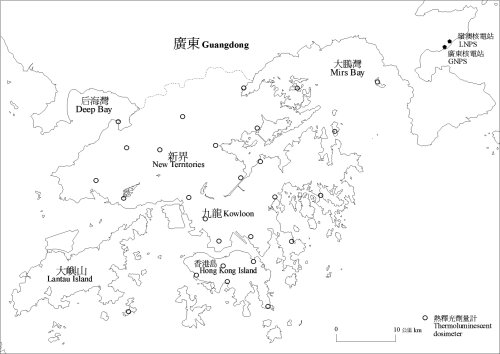
Figure 3 TLD network of ERMP.
How does a TLD measure radiation?
The TLDs contain crystals of the lithium fluoride (LiF) and calcium fluoride (CaF2) type. When a TLD is exposed to ionizing radiation at ambient environment, the radiation interacts with the crystal in the TLD and ionizes some of the crystal atoms, producing free electrons. Some of these free electrons of higher energy are trapped in the crystal. When the TLDs are heated in a reader machine back at the laboratory, heating causes the trapped electrons to release from the crystals and relieve the captured energy as light, hence the name thermoluminescent. The amount of light is counted by the photomultiplier tubes of the reader machine. As the amount of light is proportional to the radiation absorbed by the crystal, the ambient radiation level at the monitoring site over the measurement period can be calculated. The crystals can then be re-used after annealing to remove any residual energy.
Is TLD used elsewhere?
TLD is also employed in personal radiation monitoring of radiation workers in Hong Kong. All radiation workers who operate x-ray machines, administer radiation therapy, or are exposed to sources of gamma or high-energy beta radiation are generally required to wear one or more TLDs. The TLDs may be of a whole body type and/or a finger type. Their received dose will be read out from their personal TLDs on a regular basis. In Hong Kong, the Radiation Health Unit of Department of Health provides a centralized personnel radiation monitoring service to monitor the radiation exposure received by workers to ensure their overall exposure falls within the limits prescribed by law.
What is a personal TLD like?
The whole body type TLD is a dosimeter card contained in a plastic case holder. The dosimeter card contains chips of thermoluminescent LiF or CaF2 crystal. There are different filters above the chips for discriminating the radiation types and measuring the appropriate dose quantities. The dosimeter card is uniquely identified by a bar code and each TLD is distinguished by the user name labeled on the holder.
The finger type TLD is a ringlet dosimeter assembled with a plastic finger ring. The LiF or CaF2 crystal is embedded in a small ring of the TLD. The ring which is uniquely identified by a printed bar code, records the radiation dose received by the worker. Finger type TLD is suitable for personnel whose hands are directly exposed to radiation, e.g. x-ray machine operator and radiation laboratory staff to ensure more accurate dose quantities are recorded.
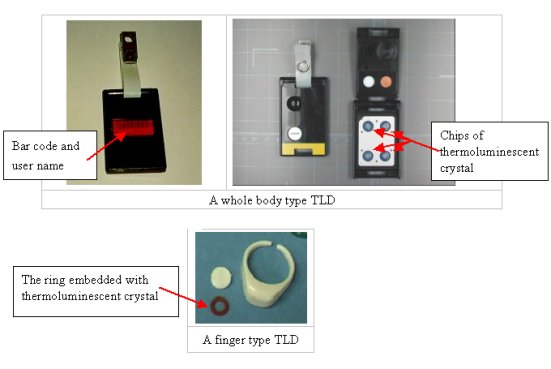
Figure 4 The whole body type TLD and finger type TLD.