On Rainstorm Warning and Localised Heavy Rain
23 May 2026
YEUNG Yat-long, WONG Tsz-kwan
During the rainy season, the Observatory sometimes receives enquiries about thunderstorms or heavy rain. There are occasions when the Observatory has issued a Rainstorm Warning Signal, and some members of the public experience very heavy rain, while others find the rain not particularly heavy. Why does this happen?
Although Hong Kong is small, its terrain is rather complex. Mountains, coastlines, the urban environment, as well as the movement and development of different weather systems, can all affect the formation, intensity, extent and duration of rain areas. Even for the same rainstorm, rainfall amounts over different parts of the territory can vary significantly. Such situations, with heavy rain affecting some areas while other places experience only light rain, are not uncommon during rainstorms. The Observatory fully understands that members of the public in different locations may have rather different impressions of the same Rainstorm Warning Signal.
Science-based assessment
When issuing weather warnings, the Observatory always makes assessments based on science, with safeguarding public safety as the foremost consideration. In issuing Rainstorm Warning Signals, the Observatory takes into account the development trend and movement of rain areas, the general rainfall situation over Hong Kong, and the associated risks, among other factors. The assessment is not based on any particular geographical area, such as the urban areas or the New Territories.
Take the Red Rainstorm Warning Signal issued on the morning of 14 June 2024 as an example (Figure 1). At that time, most parts of the New Territories were affected by rainstorm, while the rain over Lantau Island, Hong Kong Island and parts of Kowloon was not particularly heavy.
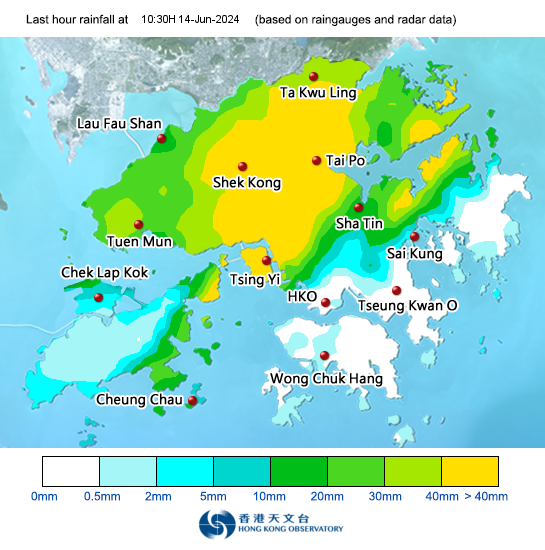
Figure 1. Past one-hour rainfall distribution at 10:30 a.m. on 14 June 2024
However, we understand that rain over individual areas can develop very rapidly and may pose a threat to public safety. Therefore, when exceptionally heavy rain affects individual areas, but the rain has not extended to widespread areas of Hong Kong, the Observatory will issue the Localised Heavy Rain Advisory, listing the affected areas and rainfall amounts, to alert members of the public the possible flooding due to heavy rain in those areas so that precautionary measures can be taken early. For the northern part of New Territories, the Observatory also has in place the Special Announcement on Flooding in the northern New Territories to alert the public to possible flooding in the low-lying plains of the area.
Application of artificial intelligence in rainstorm forecasting
Accurately predicting the precise timing, location and amount of heavy rain remains a major challenge for the global scientific community. Nevertheless, the Observatory has been making continuous efforts to apply the latest technology to enhance its capability in forecasting heavy rain. As introduced in an earlier blog article, the Observatory has already implemented a number of artificial intelligence rainfall nowcasting models in operational use to better support weather forecasting and warning services. Preliminary analysis shows that AI rainfall nowcasting models can predict the movement and intensity changes of rain areas more accurately than traditional extrapolation methods.
However, Hong Kong is small and its terrain is complex, while development of rainstorm could be rapid and highly random. Artificial intelligence still cannot guarantee accurate prediction of the position and intensity of rain areas in the next one to two hours every time.
As the technology continues to mature and new forms of observational data are brought into use, the Observatory will continue to develop and apply artificial intelligence techniques to further enhance rainstorm forecasting. Looking ahead, the Observatory will continue to be science-based, with safeguarding public safety as our primary mandate, and will strive to provide timely and clear information to the public amid rapidly changing weather conditions.